One of the most significant transformations in legal operations is the rise of the modern, intelligent and integrated legal extranet for secure client collaboration. The competitive legal market of 2025 demands more than expertise by the hour, it requires innovation in client service. An intelligent legal extranet is becoming central to this transformation.
Simply providing high-quality legal services is no longer enough—clients expect added-value beyond the billable hour. This means enhanced collaboration, useful insights, and seamless access to critical case information through a secure legal extranet environment. Firms that embrace technology to deliver these benefits foster stronger client relationships and build long-term loyalty. Conversely, those that resist digital transformation risk losing business to more agile, tech-enabled competitors who offer more efficiency, better communication, and data-driven insights through modern legal extranet solutions.
What is an extranet vs a client portal?
An extranet is a private network that allows controlled access to external users. In the legal sector, a legal extranet enables secure collaboration between law firms, clients, and external partners. Originally extranets were private networks that were extended to be accessed externally. This evolved over time to specialized web-based portals that are typically completely segregated from the environment where the internal users do their actual work, forming the foundation of today’s modern legal extranet platforms.
A client portal is a specific type of extranet uniquely tailored for client interactions. It provides each client with a personalized, secure, and compartmentalized space and connected matter specific workspaces to access their documents, find relevant contacts and firm-specific information, and communicate or collaborate via one or more channels.
Why do law firms need a modern legal extranet?
Just as consumers expect seamless access to banking and service portals, corporate clients demand the same level of convenience from their legal service providers. For a while, a secure, always-available extranet has been a critical tool for law firms. However, traditional - or now often termed "legacy" - client portals come with high costs, requiring specialized expertise, complex licensing, and extensive infrastructure. Moreover, they often fail to deliver the intuitive, user-friendly experience today's clients expect from their suppliers and from a modern legal extranet platform.
In an increasingly competitive legal market, client satisfaction and retention are the cornerstones of success. A modern, intelligent extranet keeps clients informed, engaged, and empowered - strengthening relationships and enhancing their overall experience with your firm through a secure and integrated legal extranet environment.
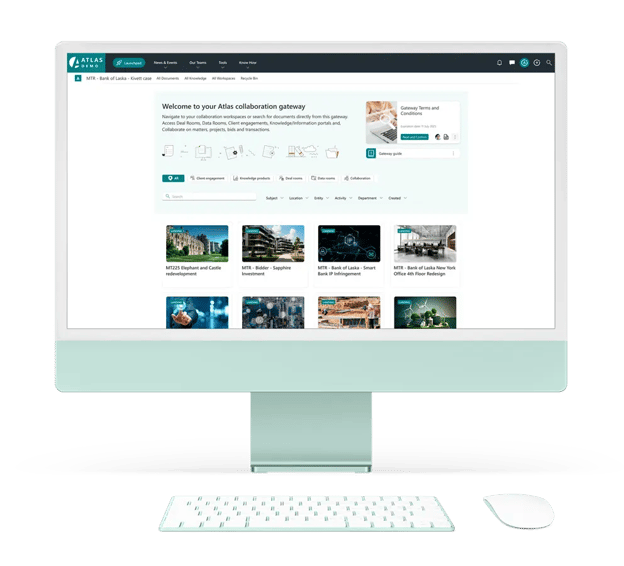
5 reasons why intelligent legal extranets are essential for law firms
With digital disruptions and transformations shaping and reshaping industries, time and time again, legal firms that fail to modernize risk falling behind and will, at best, see their profits eroding. Here’s why intelligent and integrated extranets are essential to stay competitive in today’s legal extranet-driven landscape:
1) Knowledge as a value-added service
While document sharing is a primary function of legal extranets, they should offer more value than that to clients. An intelligent extranet can elevate the client experience by providing valuable insights, including legal updates, industry news, and relevant alerts tailored to clients' business interests. By broadening access to relevant knowledge, it fosters deeper client engagement and positions the firm as a proactive, trusted advisor.
2) Self-serve with confidence
A legal extranet should offer intuitive, easy-to-use and secure self-service features for all users:
- Simplify the complex process of setting up external users with automated provisioning tools and a user-friendly 'guest' experience, reducing the risk of security errors.
- FAQs let your clients simply find answers to the questions and these can be automatically displayed in the context of the page that the user is in.
- Mandatory Reads – allowing your client’s users to highlight and track important reading materials
- Atlas “Add It” contribution experiences, to load documents into correct folders, to submit new questions, to complete forms, to automatically generate standard documents, and more.
- Atlas Knowledge Assistant, to summarize complex materials, to ask plain English questions against legal documentation, to translate to other common languages or to analyze and compare documents with respect to specific clauses or intent.
3) Strong user focus with conversational AI
A well-designed legal extranet prioritizes a seamless, intuitive, and highly personalized user experience, ensuring that external users can easily navigate and access the information most relevant to them. Beyond just functionality, a modern extranet enhances engagement with conversational AI.
Legal extranets can really be taken to the next level by integrating conversational AI capabilities that allow your clients to securely query client-specific data and documents with precision.
With conversational AI, clients can instantly query secure and relevant data, such as their own legal agreements, deeds or supporting information, saving time on manual searches. This also saves the firm significant time, by reducing trivial queries for which hours cannot be billed. For example, in high-volume, high-speed transactions, clients can query specific terms (e.g., “Which contracts contain indemnity clauses?”) and receive an instant, structured answer, eliminating hours of manual review.
4) Integrated experience
To maximize efficiency and user adoption, a legal extranet must seamlessly integrate tools that both lawyers and clients already use daily such as Microsoft 365. Legal professionals and clients can collaborate effortlessly without switching between multiple platforms. This integration ensures that case documents, communications, and workflows remain centralized, reducing inefficiencies and improving visibility.
A future-proof extranet solution must also have the capability to be extended to supports seamless integration with existing legal applications—such as the core practice management or finance management system.
5) Strong data security and compliance
Secure and well governed extranets ensure that sensitive legal information is protected through encryption at file level, multi-factor authentication of the user, and controlled access to the workspaces. It may be counter-intuitive, but isolated systems with separate user records (with usernames and passwords) for organizations to manage, increase the attack surface and the complexity of a well-governed security perimeter.
Extranets can certainly help legal firms meet compliance standards by maintaining detailed audit trails, ensuring data governance, and reducing the risk of human error. The risk of compliance issues due to outdated, unsupported or legacy platforms is however real and any incident – even if quickly mitigated – can have a direct impact on customer retention and your firm’s reputation.
Benefits of investing in a legal extranet
- Increases client satisfaction and retention with reuse and sharing of valuable knowledge assets that you already manage.
- Bring lawyers and client teams together to create better and lasting relationships within a secure legal extranet workspace.
- Easy and secure access to legal knowledge, experts, processes, and tools.
- Rapid deployment and adoption by using familiar Microsoft tools.
- Improved competitive advantage for bidding for and securing new clients.
- Significantly lowers costs by eliminating costly license fees and reduction of administrative and support for legacy or non-M365 based platforms.
Overcoming barriers to adopt legal extranets
When firms in some cases still hesitate to implement modern approaches to extranets, we have seen that this is mainly due to the perceived risk of making changes to their current client portals as well as senior partners in firms having grown used to a specific product. When taking emotion and resistance to change out of the equation, the facts are however that the modern extranets score higher for their user-friendly interfaces, they are more cost-effective, and they are built with more robust approaches to security and compliance.
Building an innovative and value-added client experience is a necessity
Embracing modern extranets is a necessity for delivering exceptional client experiences, helping firms maintain their competitive edge. Products such as Atlas Intelligent Knowledge platform assist law firms in going further faster, to deliver outstanding extranet experiences that offer exceptional value and ROI. Looking to learn more? Download our latest e-book "The Essential Guide to Legal Extranets".
FAQ
What is a legal extranet?
A legal extranet is a secure digital workspace enabling law firms to share information and collaborate with clients and external partners. It often includes matter-specific access, secure document exchange, and collaboration tools.
How does a legal extranet differ from a client portal?
A client portal is a type of legal extranet tailored for client access, while a legal extranet may include broader external stakeholder collaboration and additional features beyond just client interaction.
What are the key benefits of using a legal extranet?
Key benefits include improved client engagement, secure document sharing, enhanced collaboration, integrated workflows, and better compliance.
Is a legal extranet secure for sensitive legal data?
Yes. Modern legal extranets use encryption, authentication controls, and audit trails to protect confidential legal information and meet compliance standards.
How can law firms ensure successful adoption of a legal extranet?
Successful adoption comes from easy onboarding, clear client communication, intuitive design, and integration with tools lawyers already use.
Legal extranets: Useful resources
You may also be interested in reading:
/People/Speakers/Gabriel%20Karawani%20speaker.png?width=51&height=51&name=Gabriel%20Karawani%20speaker.png)