Could AI help law firms preserve not just what their most experienced lawyers know, but how they think?
For decades, knowledge management professionals have grappled with one of the most difficult challenges of capturing the expertise that resides in people's heads. Law firms invest in precedent banks, knowledge repositories, expertise directories and lessons learned programs. These are valuable resources, but they capture only part of the knowledge that makes experienced lawyers effective.
What about the judgment developed over decades of practice? The instinct to recognize a difficult negotiation, the ability to anticipate a client's concerns or the reasoning behind choosing one approach over another? Much of this knowledge is difficult to articulate, let alone document.
At the 2026 KM&I for Legal conference in New York, I attended a fascinating session with Dr. Megan Ma from Stanford Law School exploring a potential new approach: AI personas as the next generation of institutional memory.
Her research raises an important question for the future of knowledge management: Could AI help firms preserve and transfer expertise that has traditionally been difficult to capture?
What are AI personas?
An AI persona is an AI system designed to represent aspects of a particular individual's knowledge, preferences, experience or decision-making patterns. Unlike a general purpose AI assistant, which draws on broad training and retrieved information, an expert persona aims to reflect the professional perspective of a specific individual.
For example, an AI persona representing a senior corporate lawyer might be designed to help colleagues explore:
- How that lawyer typically approaches commercial negotiations.
- Which risks they prioritize and why.
- How they assess alternative contractual positions.
- What lessons they have learned from previous matters.
- How their approach differs across clients, industries or jurisdictions.
The objective is not to reproduce the person or replace professional judgment. It is to create another way for colleagues to access, interrogate and learn from documented expertise.
What is Stanford Law researching?
Dr. Megan Ma is Executive Director of Stanford Law School's Legal Innovation through Frontier Technology Lab, known as liftlab. Stanford's research into AI personas explores whether the experience of senior legal practitioners can be represented in interactive AI systems.
In a March 2025 account published by BYU Law, Ma and her colleagues described their work on an AI Senior Expert, using interviews with experienced practitioners and their edits to documents as inputs. Stanford Lawyer's April 2026 feature, Law, Disrupted, also describes the personas project and its potential application to legal practice and associate training.
At KM&I, Ma shared her methodology and reported approximately 85% alignment with the individual being modeled during testing. That is an intriguing result, although the public material I found does not establish the precise evaluation methodology or the circumstances under which that alignment was measured. What particularly interested me was the potential application to retiring partners.
The retiring partner problem: When expertise walks out the door
Consider a senior partner approaching retirement after 30 years of practice. The firm may retain thousands of documents they have authored or reviewed, including precedents, agreements, legal opinions and client advice. However, those documents may not reveal the commercial considerations behind a negotiation, the subtle risks that influenced a recommendation or the experience that led the partner to reject an otherwise plausible approach.
Traditional knowledge transfer often relies on interviews, mentoring, handover documents and informal conversations. These remain important, but they are difficult to scale. An AI persona could provide a complementary approach, allowing future generations of lawyers to explore the experience of senior practitioners through structured, interactive conversations.
Imagine an associate asking:
How would this partner approach a client requesting an unusually aggressive limitation of liability?
Rather than simply retrieving a precedent, a persona might explain the considerations, tradeoffs and historical examples associated with that partner's approach.
From knowledge repositories to interactive institutional memory
This research connects to a broader evolution in knowledge management. Traditional KM systems are often designed around explicit knowledge: information that can be documented, classified, stored and retrieved.
Yet some of a firm's most valuable knowledge is tacit. It is embedded in experience, professional judgment, relationships and established ways of working. AI personas suggest another potential interface to that knowledge.
|
Traditional KM approach
|
Potential AI persona capability
|
|
Precedent repository
|
Explore the reasoning behind precedent choices
|
|
Expertise directory
|
Interact with a representation of an expert's documented perspective
|
|
Lessons learned database
|
Ask contextual questions about previous decisions
|
|
Partner retirement interview
|
Preserve selected insights in a reusable conversational format
|
|
Mentoring and training
|
Rehearse scenarios and explore alternative approaches
|
These are potential applications, not established outcomes of the Stanford research.
What does the broader AI research tell us?
Two research papers provide useful context for understanding the technical and organizational possibilities.
Generative Agents: Memory, reflection and planning
The 2023 paper Generative Agents: Interactive Simulacra of Human Behavior explores how AI agents can simulate believable behavior through an architecture combining memory, reflection and planning. The researchers demonstrated the approach using 25 simulated agents interacting in a virtual environment.
The relevance to institutional memory is conceptual. Rather than treating memory as a static collection of documents, the architecture retrieves previous experiences and uses reflections on those experiences to inform subsequent behavior. However, believable simulated behavior should not be confused with faithful reproduction of an actual professional's judgment.
Collaborative Gym: The importance of human involvement
The paper Collaborative Gym: A Framework for Enabling and Evaluating Human-Agent Collaboration examines how humans and AI agents collaborate on tasks. The researchers found that collaborative agents outperformed autonomous counterparts in several evaluated tasks, while also identifying persistent communication and situational awareness failures.
This offers an important lesson for the design of AI personas. The most useful expert persona is likely to be one that supports human learning, encourages questions and makes its reasoning available for examination.
Five considerations for law firms exploring AI personas
The opportunity is compelling, but there are significant knowledge management and governance questions to address.
-
Capture expertise while the expert is still available
Interviews, scenario discussions, annotated documents and explanations of previous decisions could provide useful inputs. Expert participation also creates opportunities to validate whether the representation is faithful.
-
Distinguish personal judgment from firm policy
A partner's preferred approach is not necessarily the firm's approved position, current legal advice or an appropriate response for every client. Personas need clear boundaries.
-
Preserve context and provenance
A recommendation made for one client, jurisdiction or commercial situation may not apply elsewhere. The underlying knowledge needs sufficient context to explain where it came from and when it is relevant.
-
Build in consent, confidentiality and governance
Using an individual's professional experience to construct a persona raises questions about consent, intellectual property, client confidentiality, access rights, ongoing maintenance and the use of the persona after the individual leaves.
-
Evaluate the persona for its intended purpose
An AI persona that sounds convincing is not necessarily accurate. Firms need to assess whether it faithfully represents the expert's documented perspective, identifies uncertainty and distinguishes historical reasoning from current requirements.
Why knowledge infrastructure matters
AI personas could become an important new way to activate institutional knowledge, but their usefulness will depend heavily on the quality of the knowledge supporting them.
A firm's existing documents, matter histories, client intelligence, expertise records and lessons learned provide valuable context. Connecting these sources, maintaining provenance, applying governance and keeping information current are all relevant to developing trustworthy knowledge applications.
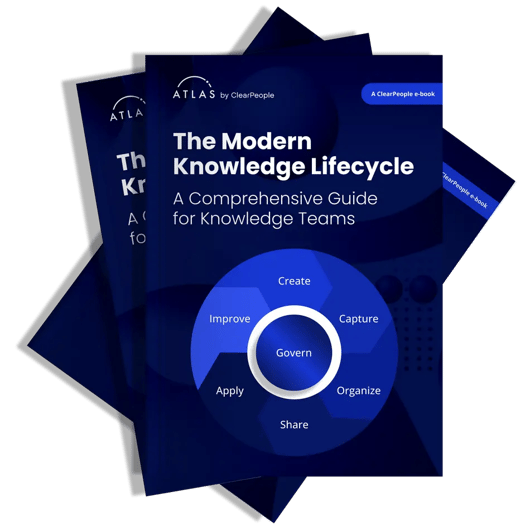
This is where the modern knowledge lifecycle becomes particularly important. Knowledge needs to be captured, connected, governed and activated, then continuously reviewed and improved. An AI persona should not be treated as an isolated experiment or a static digital representation. It should be considered within the firm's broader knowledge strategy.
Could AI personas become the next generation of expertise directories?
Today's expertise directories typically help people discover who knows what, including lawyers’ experience, skills, matters, publications and professional interests. An AI enabled expertise directory could go further by allowing colleagues to explore selected knowledge and perspectives associated with an expert, subject to appropriate consent and controls. That would represent an evolution from expertise discovery toward expertise transfer.
There is also an important distinction between a living expert's persona and one preserved after retirement. A living expert can review, correct and develop their representation. A retired expert's persona may become increasingly outdated unless the system clearly distinguishes preserved historical expertise from current legal knowledge.
Final thoughts: Preserving more than documents
The KM profession has long understood that knowledge is more than information stored in systems. Dr. Megan Ma's research offers a fascinating glimpse of how AI might help preserve and transfer some of that experience.
We should be careful not to confuse simulated expertise with the person behind it. Nor should we assume that an AI persona can replace the judgment of an experienced lawyer. The potential is worth exploring.
The next generation of knowledge management may be as much about preserving how people think as preserving what they know.
For law firms facing partner retirements, succession planning and the constant challenge of developing the next generation of legal talent, that is a conversation worth having.
FAQs
What is an AI persona in a law firm?
An AI persona is an AI system designed to represent selected aspects of a legal professional's expertise, preferences or reasoning patterns. It may draw on interviews, annotated documents and other authorized knowledge sources to support learning and knowledge transfer.
Can AI preserve a retiring partner's knowledge?
AI may help capture and make selected aspects of a retiring partner's expertise more accessible. However, reproducing professional judgment reliably remains a research and evaluation challenge. AI personas should complement structured knowledge transfer and mentoring.
How are AI personas different from expertise directories?
Traditional expertise directories identify people with relevant experience. AI personas could potentially allow colleagues to explore selected knowledge and reasoning associated with those experts through conversational interaction.
What are the risks of AI personas in legal practice?
Important risks include inaccurate representation of an expert's judgment, outdated information, disclosure of confidential material, unclear consent, misleading authority and inappropriate reliance on AI generated recommendations.
What is the relationship between AI personas and knowledge management?
AI personas are a potential application of organizational knowledge. Their design depends on knowledge capture, contextualization, governance, provenance, access controls and ongoing evaluation.
References and further reading
- Stanford Law School, Law, Disrupted, April 2026.
- BYU Law, The Era of Human AI Collaboration: Dr. Megan Ma and Pierce Kelaita, March 2025.
- Stanford Law School, Legal Innovation through Frontier Technology Lab.
- Park et al., Generative Agents: Interactive Simulacra of Human Behavior, 2023.
- Shao et al., Collaborative Gym: A Framework for Enabling and Evaluating Human-Agent Collaboration, revised August 2026.
- Stanford Law School, Dr. Megan Ma's publications.